

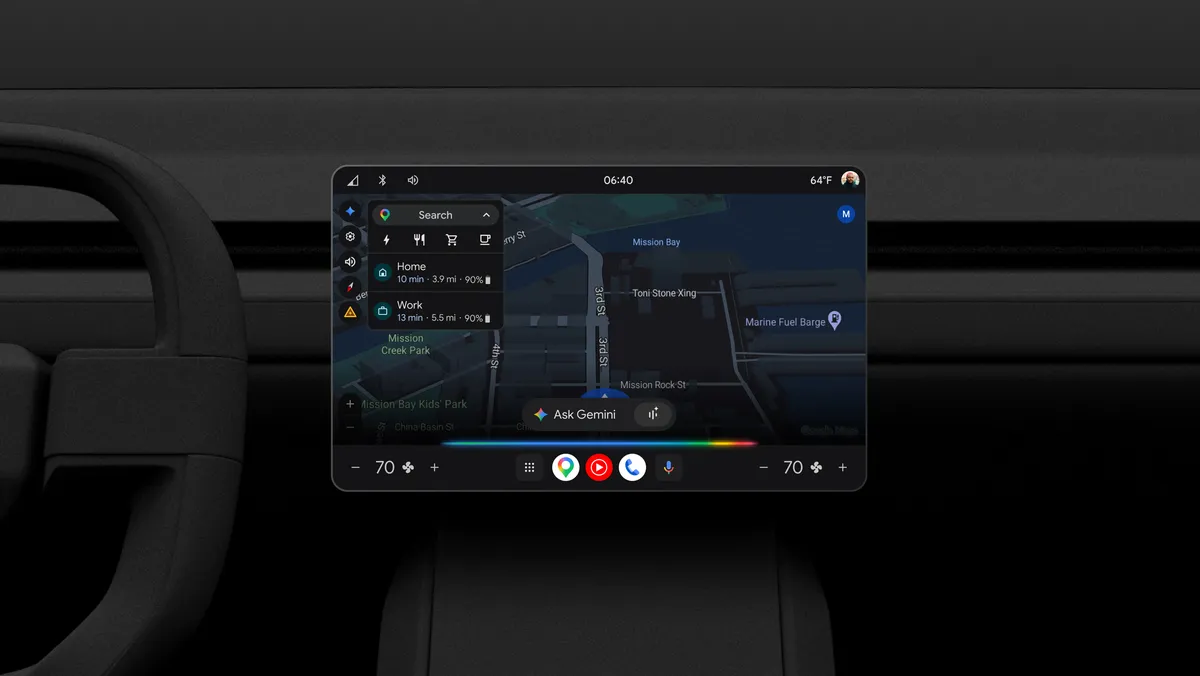
Google’s Gemini Car Rollout Brings AI to the Dashboard
Google has announced that its Gemini AI assistant will be integrated into select vehicles, bringing conversational AI directly to the dashboard. This move allows drivers to use natural language for navigation, music control, messaging, and more, without taking their hands off the wheel. The rollout begins with compatible Android Auto systems, offering features like continued conversation, where the AI remains active and context-aware even after an initial query. This represents a significant step forward in making AI assistants practical for smart homes and now smart cars.
Key Facts:
- Gemini AI will be available in vehicles through Android Auto integration.
- Features include natural language control for navigation, calls, and media.
- Continued conversation mode allows seamless multi-step interactions.
- Rollout starts with select car models and will expand over time.
- Aims to reduce driver distraction by enabling voice-only commands.
Fitbit App Becomes Google Health as AI Coaching Takes Center Stage
The Fitbit app is transitioning into Google Health, marking a deeper integration of Fitbit's fitness tracking with Google's AI capabilities. This rebranding comes with enhanced AI coaching features that analyze user data to provide personalized health recommendations. Users can expect more intelligent insights into sleep patterns, exercise routines, and overall wellness.
Key Facts:
- Fitbit app is being replaced by the Google Health app.
- AI coaching provides personalized fitness and health suggestions.
- Data from Fitbit devices will power Google's health algorithms.
- Existing users will see an automatic update and data migration.
- New features include stress management and sleep quality analysis.
Amazon Extends Price History Tool to One Year, Providing Much-Needed Transparency Around Deals
Amazon has updated its price history tool to show price changes over the past year, up from the previous three months. This improvement gives consumers a much clearer view of whether a deal is genuinely a discount or just a temporary price spike. The tool, accessible on product pages, now displays a graph of price fluctuations, helping shoppers make informed decisions, especially during major sales events like Prime Day and Black Friday.
Key Facts:
- Price history graph now spans 12 months instead of 3 months.
- Aims to combat deceptive pricing and fake discounts.
- Available on Amazon.com product pages for eligible items.
- Data includes list price, sale price, and lowest price over time.
- Helps consumers identify true bargains vs. inflated original prices.
Samsung’s Answer to Meta’s Ray-Ban Smart Glasses Revealed in Leaked Images
Leaked images have surfaced showing Samsung's upcoming smart glasses, which appear to be a direct competitor to Meta's Ray-Ban Stories. The design resembles traditional eyewear with integrated camera modules and touch controls. Samsung is reportedly partnering with a major eyewear brand to bring the glasses to market, likely incorporating features like voice commands, AI assistants, and augmented reality overlays.
Key Facts:
- Leaked images show a sleek, glasses-like form factor with cameras.
- Expected to support Google's Gemini AI or Samsung's Bixby.
- Release date is speculated for late 2024 or 2025.
- Will compete with Meta's Ray-Ban smart glasses and Apple's potential AR wearables.
- Features may include real-time translation, navigation hints, and media capture.
Apple Patches iPhone Bug Exploited by Police to Recover Deleted Chats, But Privacy Questions Persist
Apple has released a security patch for an iPhone vulnerability that allowed law enforcement to recover deleted chats from certain messaging apps. The bug, present in iOS versions prior to the update, could be exploited with specialized forensic tools to access data that users believed was permanently erased. While Apple has now fixed the issue, critics argue that the problem highlights ongoing privacy concerns with data deletion and device security.
Key Facts:
- Vulnerability allowed recovery of deleted app data, including encrypted chats.
- Exploited by police through forensic software like Cellebrite.
- Apple released iOS update to patch the bug.
- Privacy advocates call for stronger deletion guarantees.
- Apple emphasizes that it does not create backdoors, but this was a unintended loophole.
Gemini’s ‘Continued Conversation’ Feature Makes Google’s AI More Practical for Smart Homes
Google is rolling out a 'Continued Conversation' feature for Gemini in smart home devices, allowing the AI to remain active after an initial command without needing to say “Hey Google” again. This makes interactions feel more natural, particularly for multi-step tasks like setting timers, checking the weather, and controlling smart lights in sequence. The feature builds on the success of similar implementations in Google Nest speakers but is now enhanced by Gemini's deeper contextual understanding.
Key Facts:
- Continued Conversation is now available for Gemini on smart speakers and displays.
- Users can ask follow-up questions without repeating the wake word.
- The AI maintains context for up to 30 seconds after the last command.
- Works with routine automations and household control.
- Improves usability for seniors and those with mobility issues.
Amazon Ending Support for Older Kindles Next Month, Showing the Hidden Cost of “Forever” Tech
Amazon has announced that it will end support for several older Kindle models, including the Kindle (10th generation and earlier), Kindle Paperwhite (7th generation), and Kindle Oasis (1st generation). Starting next month, these devices will no longer receive security updates, software improvements, or access to the Kindle Store. Users are urged to upgrade, but the move underscores the planned obsolescence in e-readers and the importance of considering long-term support when purchasing tech gadgets.
Key Facts:
- Support ends for Kindle models released before 2019.
- Devices will still work for reading sideloaded content but lose store access.
- Amazon offers trade-in discounts for newer models.
- Similar phase-outs have occurred for older Fire tablets.
- Critics argue that 'forever' tech claims are misleading.
Casely Power Banks Recalled Again Following Mid-Flight Explosion
Casely has issued a second recall of its power banks after a mid-flight explosion incident on a commercial airline. The affected power banks, models 10K and 20K, can overheat and catch fire. The U.S. Consumer Product Safety Commission (CPSC) warns consumers to stop using them immediately. This is the third such recall in the portable charger industry in 2024, raising questions about lithium-ion battery safety and the adequacy of current manufacturing standards.
Key Facts:
- Recall affects Casely 10K and 20K power banks sold between 2022-2024.
- Incident involved explosion in an overhead bin during flight.
- CPSC urges immediate disuse and return for refund.
- Previous recall in 2023 for similar overheating issues.
- Industry calls for stricter battery safety regulations for air travel.
These stories represent the dynamic landscape of consumer technology, where AI, privacy, and safety continue to intersect. From the integration of AI assistants in cars and homes to the pitfalls of device longevity and battery risks, consumers must stay informed. The expansion of price transparency tools by Amazon marks a positive step, while the iPhone bug patch highlights that even major platforms can have privacy gaps. As Samsung enters the smart glasses arena and Fitbit merges into Google Health, the boundaries between devices, data, and daily life blur further. Watch for these developments in the coming weeks as they reshape the way we interact with technology.
Source: Techopedia News