

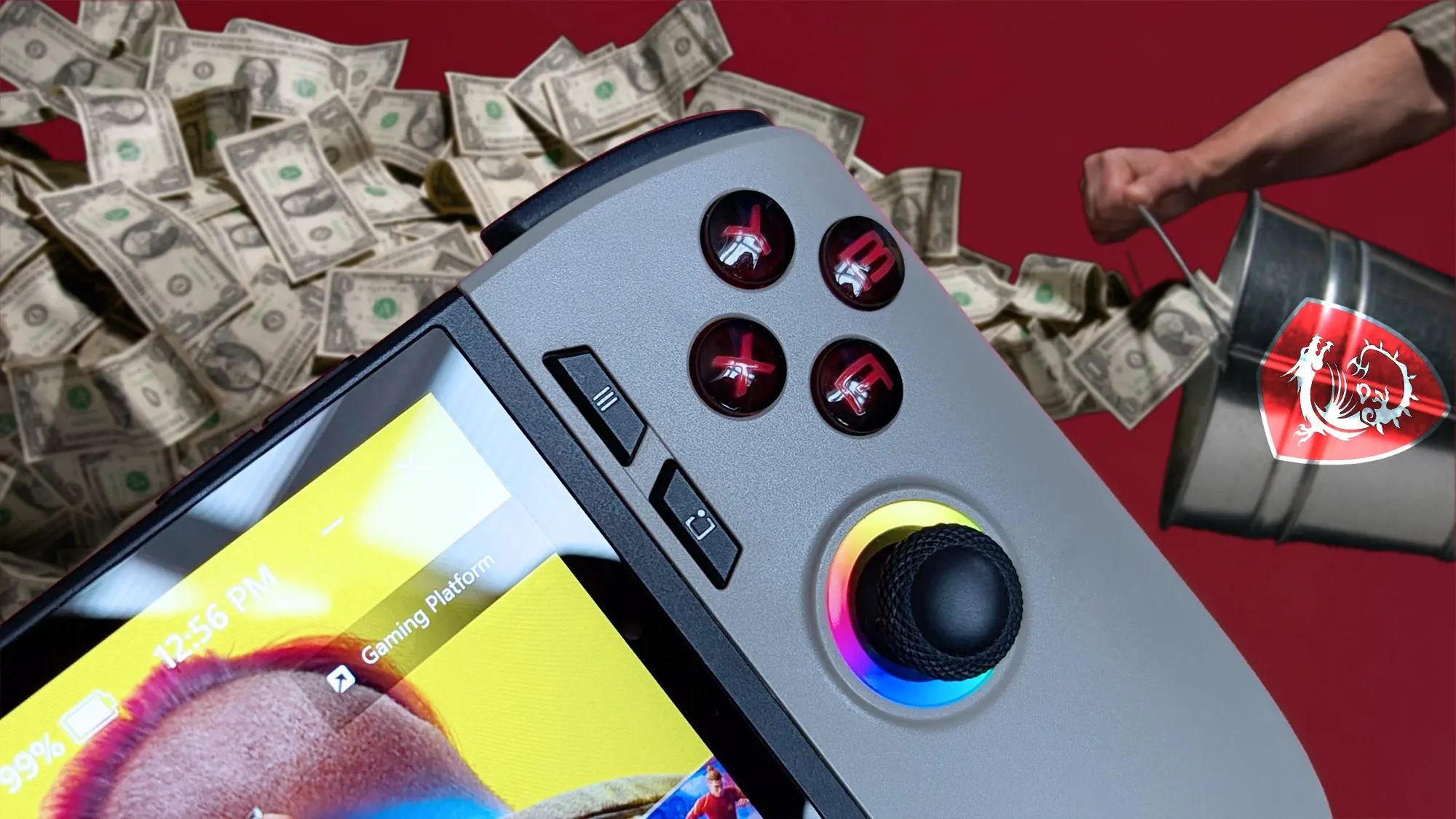
The handheld gaming market, once dominated by the affordably-priced Nintendo Switch and later the Valve Steam Deck, has entered a new era of premium devices that blur the line between portable consoles and high-end gaming laptops. MSI, a company traditionally known for its desktop components and gaming laptops, is now pushing the boundaries further with its upcoming Claw 8 EX AI+. Recent reports suggest that this device is heading towards a staggering $2,000 price tag, a figure that signals a dramatic shift in consumer expectations and industry strategy.
The Rise of High-End Handhelds
The concept of a handheld gaming PC is relatively young. Valve's Steam Deck, launched in early 2022, set a baseline with prices starting at $399 for the base model, offering impressive performance for its price. That device proved that there was a substantial market for portable PC gaming. However, the Steam Deck's price-to-performance ratio quickly became a benchmark, forcing competitors like ASUS (ROG Ally), Lenovo (Legion Go), and now MSI to strive for better performance, higher resolution screens, and more premium materials. Each iteration has seen prices climb. The ASUS ROG Ally launched at $699, the Lenovo Legion Go at $699, and the original MSI Claw (Intel-based) at $699 as well. But the next generation seems to be taking a significant leap.
What Makes the Claw 8 EX AI+ So Expensive?
The Claw 8 EX AI+ is expected to feature an upgraded Intel Core Ultra processor with a dedicated AI accelerator, which is where the "AI+" branding comes from. This chip promises better efficiency and performance for both gaming and AI-accelerated tasks like upscaling and frame generation. Additionally, the device is rumored to sport an 8-inch display with a 120Hz refresh rate and possibly higher resolution than its predecessor. The build quality is expected to be more premium, with improved ergonomics and a larger battery. These hardware upgrades naturally inflate the bill of materials. However, a $2,000 price point places it in direct competition with gaming laptops that have dedicated GPUs, such as the ASUS ROG Zephyrus G14, which can often be found for less. This raises the question: what is the actual value proposition of a handheld at that price?
At $2,000, consumers could purchase a mid-range gaming laptop or even a high-end desktop CPU and GPU combination. The portability of a handheld is undeniable, but the performance gap between an integrated graphics solution (even the latest Intel Arc or AMD RDNA 3) and a dedicated RTX 4060 or 4070 laptop GPU is substantial. While AI upscaling technologies like Intel XeSS and AMD FSR help, they cannot fully compensate for the raw power difference. Furthermore, the handheld's battery life, which is already a pain point, will likely remain limited even with efficiency gains. MSI may be banking on the novelty and the desire for an ultra-portable device that can play AAA titles at 1080p with high settings, but the price may limit its audience to early adopters and enthusiasts.
The Handheld Industry's Escalating Arms Race
The phrase "losing its collective mind" in the original headline reflects a broader industry trend. Over the past year, we have seen announcements of devices like the Ayaneo Kun, which retail for over $1,200, and the OneXPlayer series that often surpasses $1,500. Even Sony's PlayStation Portal, though a different category, was criticized for its $200 price tag given its streaming-only functionality. But the PC handheld space is different: it offers a full Windows or Linux experience, but the cost of components, especially high-refresh-rate screens, fast storage (NVMe SSDs), and the latest generation of processors, has pushed prices upward. The AMD Ryzen Z1 Extreme, used in many current devices, is a powerful chip, but Intel's Core Ultra chips have not been cheap either. Additionally, memory (LPDDR5X) and cooling solutions add to the cost.
Another factor is the global semiconductor market, which has been recovering but still faces higher costs for advanced nodes. MSI's decision to use Intel's newly developed AI-focused architecture could be a differentiator, but it also likely incurs a premium. The "AI+" moniker suggests that MSI is betting on AI features becoming a major selling point, such as real-time translation, AI noise suppression, and intelligent game optimization. However, whether consumers are willing to pay a $500–$700 premium over competing devices for these features remains to be seen.
Market Reception and Audience
The $2,000 price point immediately narrows the target audience to affluent gamers, content creators who need a portable workstation for light tasks, and tech enthusiasts who want the latest gadget regardless of cost. For the average gamer, this price is prohibitive. Many will argue that if they are spending that much, they would rather buy a device with a larger screen, better thermals, and upgradable components. The handheld form factor also inherently limits ergonomics for long sessions, and the small screen may not be ideal for immersion in graphically intense games.
Furthermore, MSI is entering a market where the Steam Deck still holds a strong position due to its software ecosystem (SteamOS) and community support. Even with Windows compatibility, the Claw 8 EX AI+ will need to prove that it offers a better experience than the cheaper alternatives. The ASUS ROG Ally and Lenovo Legion Go already face criticism regarding software optimization and battery life, and a higher price only raises expectations.
Software and Ecosystem Challenges
A major hurdle for any Windows-based handheld is the user interface. Microsoft has not yet created a dedicated gamepad-friendly UI for Windows, forcing manufacturers to layer their own launchers and overlays. MSI's previous Claw used MSI Center M, which was functional but had some quirks. With the new AI+ model, MSI may integrate more AI-driven power management and game profiles. However, unless the software experience is seamless, the high hardware cost may feel unjustified. In contrast, Valve's SteamOS is tailored for handhelds, offering quick resume, a robust controller interface, and excellent performance tuning. MSI's device will rely on Windows, which can provide better compatibility with game launchers (Game Pass, Epic, etc.) but lacks the polish.
Competition and Price Comparisons
Let's look at the price landscape. The Steam Deck OLED, released in late 2023, tops out at $649 for the 1TB model. The ASUS ROG Ally Z1 Extreme can often be found for $599 or less on sale. The Lenovo Legion Go is around $699. The Ayaneo Kun (with a 7840U) is approximately $1,300 to $1,500 depending on configuration. The upcoming GPD Win Max 2 (2024) is expected to be around $1,000–$1,200. MSI's Claw 8 EX AI+ at $2,000 is a clear outlier. This positions it in a category of its own, competing more with ultra-premium gaming tablets like the ROG Flow Z13, which also has a detachable keyboard and a larger screen. But the Flow Z13 is essentially a laptop with a tablet form factor, not a handheld.
The question of whether the industry has lost its collective mind is subjective. From a business perspective, companies are trying to differentiate and push the boundaries of what a handheld can do. But from a consumer standpoint, the affordability that made the original Steam Deck a phenomenon is now slipping away. The Steam Deck succeeded because it offered an almost desktop-like gaming experience for $400. The Claw 8 EX AI+, by contrast, offers incremental gains at a disproportionate cost.
Potential Impact on the Market
If MSI can deliver a device that truly leverages AI to improve gaming performance, extend battery life, and provide a smooth user experience, the $2,000 price might be justified for a niche audience. However, history shows that premium handhelds often struggle to gain mainstream traction. The Sony PlayStation Vita, though not a PC, was a powerful handheld but failed due to high price and proprietary memory cards. The Nintendo 3DS had a rocky start due to its initial $250 price, which was later slashed. The handheld PC market is still nascent, and a device that costs as much as a high-end laptop could risk alienating the core audience.
Moreover, the handheld gaming industry is also seeing competition from cloud gaming services, which allow users to stream games to any device, including phones, tablets, and affordable handhelds like the Logitech G Cloud (which is only $349). While cloud gaming has its own limitations (internet dependency and latency), it offers a cheaper entry point. MSI's Claw 8 EX AI+ will need to prove that local processing power is worth the premium over cloud-based solutions.
Final Thoughts on the Claw 8 EX AI+
As the industry awaits official specifications and pricing from MSI, the reported $2,000 figure serves as a wake-up call. It highlights the direction hardware manufacturers are taking: more power, more features, and much higher prices. Whether this is sustainable or a bubble waiting to burst remains to be seen. For now, the Claw 8 EX AI+ stands as a symbol of a market grappling with its identity—balancing the desire for cutting-edge technology with the practical realities of consumer budgets. The device's success or failure could shape the pricing strategies of future handhelds for years to come.
Source: Windows Central News