

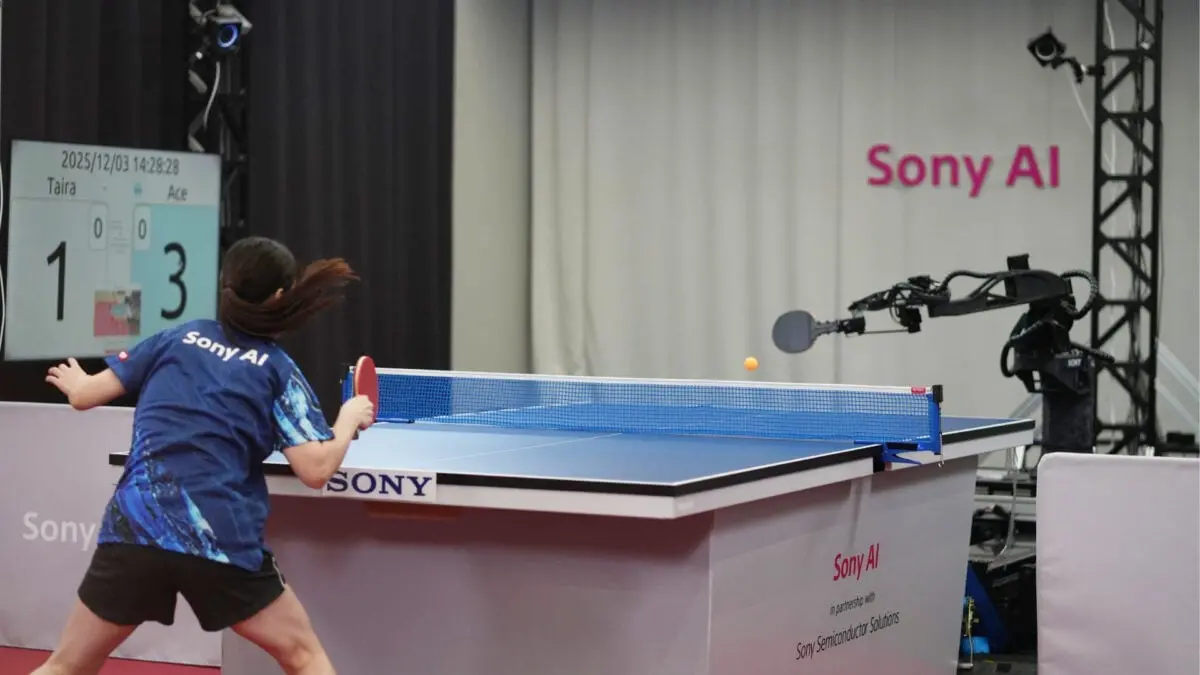
The world of competitive table tennis now boasts a new, non-human contender. Researchers at Sony's AI division have introduced Ace, an autonomous robotic system capable of matching and even defeating elite human players. Published today in the journal Nature, the study details how Ace won a majority of its matches against players with extensive experience, while also giving professional athletes a real challenge. While the novelty of a robot that can return high-speed, high-spin shots is impressive, the underlying software and hardware may have far-reaching applications beyond the ping-pong table.
The Rise of Ace
Ace is the culmination of years of research into how artificial intelligence can operate safely and effectively in the physical world. Lead author Peter Dürr explained that the project was designed to tackle the unique challenges of real-time human-robot interaction. Unlike simulated environments where AI works with perfect information, real sports like table tennis demand rapid decision-making based on noisy sensor data and unpredictable human movements. The robot had to estimate ball position, spin, speed, and trajectory in milliseconds, then generate a coordinated physical response. This combination of perception, control, and agility is a holy grail for robotics.
Historically, building robots that can outperform humans in physical sports has been enormously difficult. Table tennis, in particular, requires split-second reaction times, precision in generating spin, and the ability to anticipate an opponent’s moves. Since the 1980s, researchers have tinkered with robotic ping-pong systems, but none have achieved the level of performance demonstrated by Ace. The key breakthroughs come from Sony’s integration of advanced reinforcement learning algorithms, custom motor control systems, and a lightweight yet powerful robotic arm that can move at speeds comparable to professional human players.
Testing Against Top Talent
The researchers evaluated Ace’s abilities using the official rules of the International Table Tennis Federation (ITTF) and employed licensed umpires to officiate the matches. This rigorous setup ensured that the robot’s victories were legitimate and measurable. In April 2025, Ace faced five players classified as elite—those with at least ten years of playing experience and averaging 20 hours of training per week. It also competed against two professional athletes active in Japan’s top league: Minami Ando and Kakeru Sone. Ace won three of the five matches against elite players. Against professionals, it managed to win one game but ultimately lost both full matches.
The team did not stop there. In December 2025, Ace returned to the table with improved algorithms and hardware tweaks. This time, it defeated both elite and professional players, including one of the two pro matches. In March 2026, Ace took on top-ranked professionals, including Miyuu Kihara, who was then ranked among the world’s top 25 in women’s singles. Ace won three matches against these professionals, demonstrating a marked improvement in shooting balls faster and placing them closer to the table edges, making returns extremely difficult for human opponents.
Behind the Hardware and Software
Ace is not a humanoid robot. Instead, it consists of a single robotic arm mounted on a track that allows it to move laterally along the table. The arm is equipped with a custom paddle that can generate extreme spin. The robot’s vision system uses high-speed cameras that capture the ball’s position and rotation hundreds of times per second. A deep learning model then predicts the ball’s trajectory and spin within milliseconds. The AI brain chooses a return shot—whether to play a safe, high-percentage return or a risky, aggressive winner. The motor control system executes the shot with precision that matches or exceeds human capability.
One of the most impressive aspects of Ace is its ability to serve. In table tennis, serves are extremely difficult to return because the server can impart hidden spin. Ace learned to vary its serves in speed, spin, and placement, keeping human opponents off balance. The researchers also taught Ace to adapt its playing style mid-match based on its opponent’s weaknesses, a skill that separates elite players from amateurs.
Implications for Real-World Robotics
The significance of Ace extends far beyond table tennis. According to Dürr, the technologies developed for Ace—real-time state estimation, fast sensorimotor control, and adversarial learning—can be applied to many other domains. For instance, robots that need to interact with humans in dynamic environments like warehouses, hospitals, or even homes could benefit from the same underlying AI. The ability to operate safely and effectively alongside humans is critical for the next generation of robotics.
Safety was a key concern throughout the project. The researchers built multiple layers of fail-safes to ensure Ace never harmed a human opponent. The robot’s arm is limited in force and speed, and it stops instantly if it detects an unexpected obstacle. Such safety measures are vital if robotic systems are to be deployed in settings where they will work alongside people.
The research also highlights how AI can be used to push the boundaries of human performance. By training Ace against a variety of human styles, the team created a robot that serves not only as a competitor but also as a training partner. Professional players who faced Ace remarked on how it forced them to raise their game, because the robot never tired and could execute consistent high-quality shots.
A New Benchmark in Physical AI
While Ace cannot yet beat the absolute best in the world consistently—Ando and Kihara still hold winning records against the robot—the rapid improvement from April 2025 to March 2026 suggests that it is only a matter of time before robotic table tennis champions emerge. The researchers are not stopping here; they plan to continue refining Ace and sharing their findings with the broader AI and robotics communities.
The work represents a significant milestone at the intersection of artificial intelligence and robotics. As Dürr noted, solving the challenges of real-time, adversarial physical interaction opens doors to applications in sports, entertainment, manufacturing, and even search and rescue. Ace may be a table tennis robot today, but the technology it embodies could soon be handling tasks that require quick thinking and even quicker reflexes—tasks where human-robot collaboration becomes seamless and intuitive.
Source: Gizmodo News