

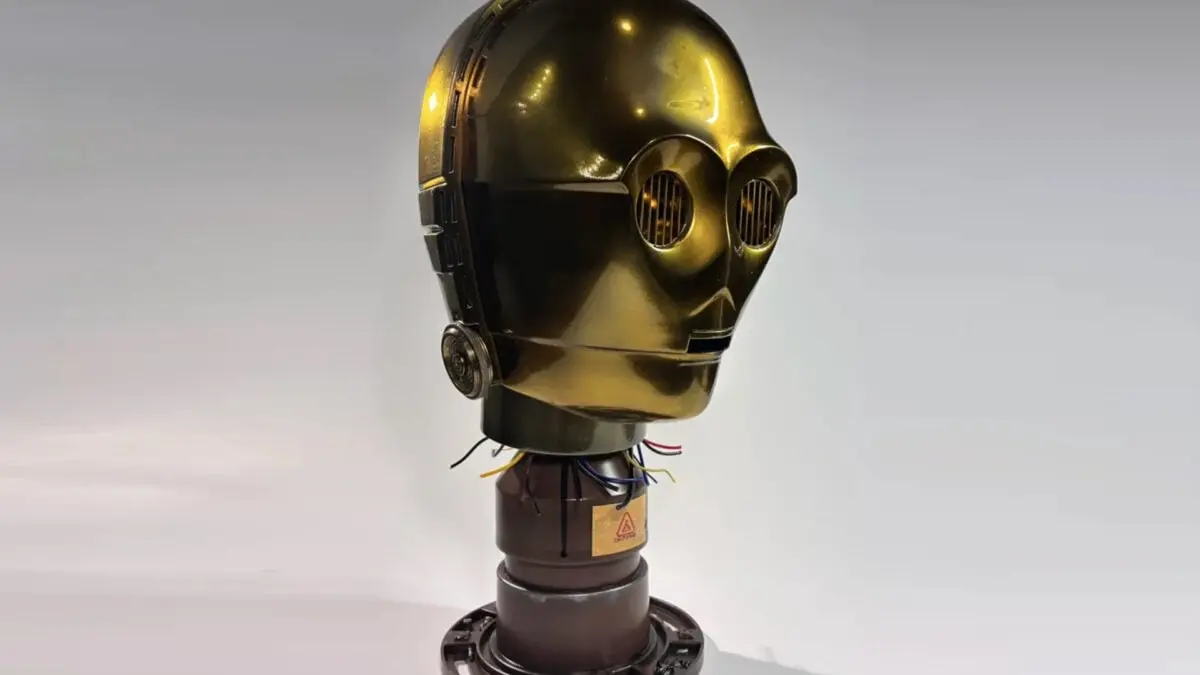
May the fourth be with you, and all that. For Star Wars Day, we're focusing on one of the galaxy's most persnickety droids: C-3PO, the golden protocol droid with a vocabulary that could rival a Victorian butler. But now, thanks to a student at Chapman University, you can build your own interactive C-3PO head that not only looks the part but also talks back to you in character, offering a genuinely immersive experience for fans of the series.
The project, created by Samuel Potozkin, combines a physical replica of Threepio's head with a custom large language model (LLM) and real-time speech processing. The result is a conversation partner that responds in C-3PO's trademark prissy, slightly exasperated tone. It's a far cry from the simple voice assistants we're used to, and it offers a playful glimpse into how AI can breathe life into beloved fictional characters.
From Auction Block to DIY Project
Earlier this year, a piece of Star Wars history made headlines when the original C-3PO head prop from The Empire Strikes Back sold at auction for over $1 million. That prop, which was separated from its owner after he wandered through the wrong door in Cloud City, became one of the most expensive pieces of Star Wars memorabilia ever sold. But while you might not have that kind of cash lying around, Potozkin's project offers an accessible alternative: you can build your own head for a fraction of the cost, albeit with a few modern enhancements.
The design is based on a 3D-printed shell that closely resembles the original film prop. The gold finish is achieved through careful painting and finishing, but the real magic lies inside. The head houses a Raspberry Pi 5, a microphone, and a speaker, along with the software stack that makes the conversation possible.
The AI Pipeline: How It Works
Conceptually, the system is straightforward. When you speak into the microphone, your audio is captured and sent to the Raspberry Pi. The Pi runs a real-time text-to-speech (TTS) converter that transcribes your speech into text. That text is then fed as a prompt to the custom LLM, which has been fine-tuned to mimic C-3PO's personality—exasperated, formal, and forever complaining about something. The LLM generates a response, which is then processed through a second TTS system that has been trained to produce a vocal tone matching the metallic, slightly reedy quality of the droid's voice.
Potozkin notes that the initial TTS output didn't quite capture the metallic resonance he wanted. To fix this, he applied a series of audio post-processing effects that sound more like a guitarist's pedalboard than a code project. &8220;A short delay line was introduced to create tightly spaced temporal reflections, and a chorus effect was applied by slightly modulating the time and pitch of duplicated signal paths, creating the impression of layered vocal resonance,&8221; he explains. The final result is eerily convincing: the voice is unmistakably C-3PO, even if it's coming from a disembodied head sitting on a desk.
DIY Community and Open-Source Details
Potozkin has published all the details of his project on GitHub, including the source code, schematics, and 3D printing files. This means anyone with a bit of technical know-how can replicate the build. The GitHub repository includes a paper that outlines the entire process, from selecting the right Raspberry Pi model to fine-tuning the LLM. The LLM itself was trained on transcripts of C-3PO's lines from the original trilogy, supplemented with dialogue from the prequels and sequels to broaden its conversational range.
The project has attracted interest from both Star Wars fans and the AI community. It's a neat example of how accessible AI tools have become: you don't need a massive server farm or a team of engineers to create a convincing conversational agent. A Raspberry Pi and some open-source software are enough to bring a fictional character to life.
Historical Context: C-3PO's Legacy in Pop Culture
C-3PO has been a staple of the Star Wars universe since the original 1977 film. Portrayed by Anthony Daniels, the character is a protocol droid fluent in over six million forms of communication, yet frequently finds himself in situations that require diplomacy—or simply running away from danger. His interactions with R2-D2 have provided some of the most memorable comedic moments in the series, and his dramatic &8220;We're doomed!&8221; has become a meme in its own right.
But Threepio is more than comic relief. He represents the idea of a machine with a personality, and his constant worry and fussiness make him surprisingly relatable. Potozkin's AI head captures that personality perfectly: it's not just a voice assistant; it's a character that will argue with you, complain about your decisions, and occasionally offer sage advice (usually about protocol).
The project also taps into a broader trend: the use of AI to recreate or emulate characters from fiction. From deepfakes to chatbots, creators are increasingly using machine learning to bring dead or fictional characters back to life. While some raise ethical questions, others, like Potozkin's head, are clearly meant for fun and education.
Practical Considerations and Future Improvements
Building the C-3PO head requires basic soldering, 3D printing, and familiarity with Raspberry Pi setup. Potozkin provides clear instructions, but he also warns that the project is not for complete beginners. The audio processing especially requires some trial and error to get right. However, the payoff is a conversation that feels genuinely immersive.
Potential future improvements include adding gesture control—perhaps having the head nod or shake when speaking—or integrating voice recognition that can handle multiple languages (since Threepio is fluent in &8220;over six million forms of communication&8221;). Potozkin has hinted that he's working on a version that can detect emotional tone in the user's voice and adjust its responses accordingly, making the droid even more personable.
For Star Wars fans, this project is a way to bring a little bit of the galaxy far, far away into their living rooms. It's also a testament to how far DIY electronics and AI have come. What was once the stuff of science fiction is now something you can build over a weekend with off-the-shelf parts and open-source code.
The project also highlights the importance of community-driven development. By sharing his work on GitHub, Potozkin has enabled others to learn, modify, and improve upon his design. This spirit of collaboration is what pushes technology forward, and it's especially fitting for a project that celebrates a franchise built on imagination and ingenuity.
Whether you're a die-hard Star Wars fan or just curious about AI-powered conversation, the C-3PO head project is worth exploring. It's a charming, well-executed piece of engineering that reminds us that technology can be playful, too. And who knows? Maybe next May the 4th, you'll be having a polite argument with a golden droid about the best route to the Death Star's trash compactor.
Source: Gizmodo News