

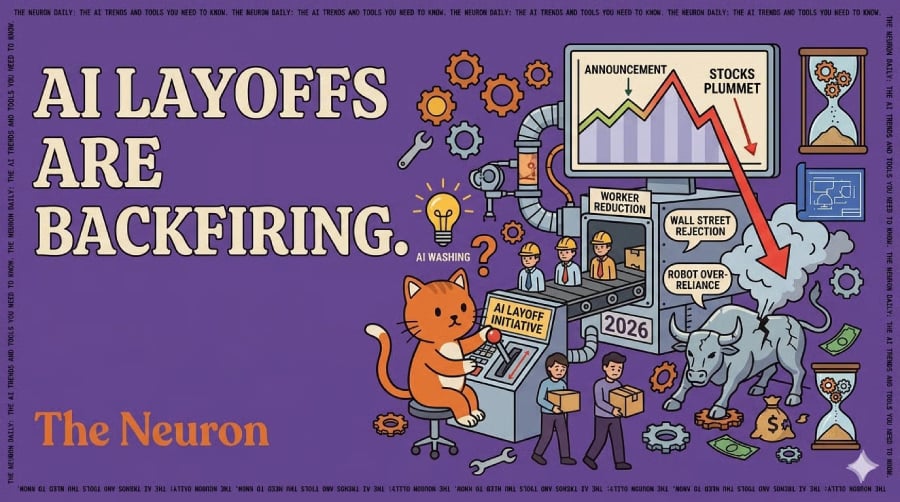
Over the past two years, the technology industry has been gripped by a wave of mass layoffs unlike any seen since the dot-com bust. From Meta to Microsoft, Google to Amazon, companies have shed tens of thousands of employees, often citing the need to “reorganize around AI” or “double down on artificial intelligence.” The logic seemed straightforward: replace expensive human talent with cheaper, faster AI tools, and reap the rewards of a leaner, more automated workforce. But as 2025 unfolds, a growing body of evidence suggests that this AI layoff boom is starting to look like a bad bet — for companies, for workers, and for the economy at large.
To understand why, it’s important to first recognize the scale of the layoffs. According to data from Layoffs.fyi, over 400,000 tech workers lost their jobs in 2023 alone. In 2024, the number remained high at roughly 150,000, with many of those cuts directly tied to AI restructuring. Companies like Duolingo cut contractors to replace them with AI translation tools, while IBM announced plans to pause hiring for roles that could be automated. The message was clear: AI is coming for the white-collar workforce, and faster than anyone anticipated.
Yet the financial returns from these decisions have been underwhelming. A report from the McKinsey Global Institute estimated that while AI could eventually boost productivity by 1.2% annually, the early adopters have seen gains closer to 0.3%. Worse, many firms are finding that AI systems require constant human oversight, data cleaning, and ethical guardrails — costs that eat into the savings from layoffs. A study by MIT researchers found that for every dollar saved on salaries, companies spent an average of 80 cents on AI implementation and maintenance.
The human toll is also becoming impossible to ignore. Layoffs have triggered a surge in burnout and disengagement among remaining employees, who are often forced to manage both their own workloads and the outputs of AI systems. Surveys by Gallup show that employee engagement in tech companies has dropped to its lowest level in a decade, coinciding with the layoff wave. This has a direct impact on innovation: when people are scared, they stop taking risks. And without risk, breakthrough ideas rarely emerge.
Moreover, the legal and regulatory landscape is shifting. The European Union’s AI Act, passed in 2024, imposes strict liability on companies for AI-caused errors, meaning that firms cannot simply fire human workers and hand over decision-making to algorithms without accepting significant legal exposure. In the United States, several class-action lawsuits have been filed against companies that used AI to screen job applicants, alleging bias — a reminder that AI is not a panacea.
Some early adopters are already backtracking. In early 2025, a major retailer quietly rehired dozens of customer service representatives after its AI chatbot caused a 30% increase in complaint escalation. A financial services firm that automated loan underwriting discovered that its model was systematically rejecting minority applicants, forcing a costly reprogramming effort. These examples underscore a fundamental truth: AI is a tool, not a substitute for human judgment.
Industry analysts now suggest that the “AI layoff boom” may have been driven more by hype and herd mentality than by sound business strategy. “Companies saw their competitors doing it and felt they had to follow suit,” explains Dr. Elena Morkan, a labor economist at Stanford University. “But many of them didn’t have a clear idea of what they wanted AI to do, or how to measure its impact. They just knew they wanted to look like AI companies.” That pressure to appear innovative, combined with the desire to boost stock prices by cutting costs, created a perfect storm for rash decisions.
There are also signs that the labor market is adapting. While routine white-collar jobs — data entry, basic customer support, some programming tasks — are indeed being automated, new roles are emerging around AI oversight, prompt engineering, and ethical auditing. But these jobs often require different skills and pay less than the positions they replace. The net effect on workers has been downward pressure on wages and job security, even as the overall employment numbers in tech stabilize.
From a macroeconomic perspective, the layoff boom could have long-term consequences for innovation. Historically, many of the tech industry’s greatest breakthroughs — from the iPhone to cloud computing — came from companies that invested heavily in human capital during downturns. By contrast, the current strategy of “AI-first, people-second” may produce incremental efficiency gains but fewer paradigm-shifting inventions. As venture capitalist Marc Andreessen famously said, “Software is eating the world.” But software is written by people, not machines.
Even within AI development itself, the layoffs are creating problems. Many of the researchers and engineers who built the AI systems are now leaving companies to start their own ventures, taking crucial expertise with them. The open-source community, meanwhile, is outpacing corporate AI labs in some areas, thanks to collaboration among independent developers who were laid off from big tech firms. It’s a stark irony: the same companies that bet everything on AI are now struggling to retain the talent that makes AI work.
Regulators are also taking notice. The U.S. Federal Trade Commission (FTC) has launched an inquiry into whether large-scale layoffs coupled with AI adoption constitute unfair business practices, especially when they disproportionately affect protected groups. The outcome of this investigation could lead to new restrictions on how companies use automation in hiring, firing, and workplace monitoring.
Meanwhile, the public mood is shifting. According to a Pew Research Center survey released in early 2025, 67% of Americans now believe that AI will replace more jobs than it creates, up from 54% in 2020. This anxiety is translating into political pressure, with several presidential candidates calling for a “human-centered” approach to technology. The phrase “AI layoff boom” has entered the political lexicon as a cautionary tale.
Given all of this, it’s worth asking: why did companies make such a massive bet on AI in the first place? Part of the answer lies in the nature of the technology itself. AI is seductive because it promises exponential returns: train a model once, and it can serve millions of users at virtually no marginal cost. But in practice, AI models degrade over time, require constant retraining, and can produce unpredictable errors. The dream of a fully automated enterprise remains just that — a dream.
There are, of course, success stories. Some companies have used AI to enhance productivity without major layoffs, instead reskilling their existing workforce. For example, a global logistics firm trained its warehouse managers to use AI-driven route optimization tools, reducing fuel costs by 15% without firing anyone. These cases suggest that the real value of AI lies in augmentation, not replacement. But such examples are the exception, not the rule.
As the dust settles, it’s becoming clear that the AI layoff boom was a gamble — and a risky one at that. The bet was that AI would deliver such overwhelming efficiency that the human cost would be justified. But early returns indicate that the efficiency gains are modest, the hidden costs are high, and the social consequences are severe. Companies that staked their future on AI at the expense of their people may find themselves in a weaker position than when they started. The lesson for 2025 and beyond: technology is only as good as the humans who design, deploy, and manage it. Cutting the humans is seldom the path to success.
Source: eWEEK News