

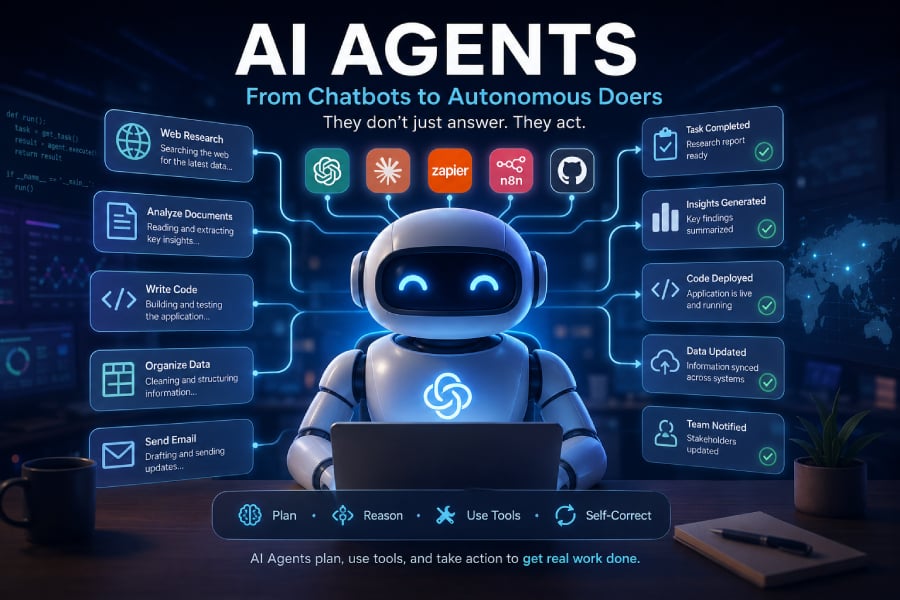
Artificial intelligence is evolving rapidly beyond simple chatbots. For the past two years, most people have interacted with AI through tools like ChatGPT, Gemini, or Claude—systems that respond to prompts and end the conversation. A new generation of AI systems, known as AI agents, is fundamentally changing that model. Unlike traditional chatbots, AI agents are designed to take action: they browse websites, analyze files, connect to apps, write code, make decisions, and complete tasks with minimal human input. If a standard chatbot is an advisor, an AI agent is a digital worker that can actually perform the job. The rise of agentic AI is reshaping technology, enterprise software, cybersecurity, automation, healthcare, finance, and software development. Major companies like IBM, OpenAI, Google, Anthropic, and Microsoft are investing heavily because researchers see agents as the next major stage of artificial intelligence.
What exactly is an AI agent?
At its core, an AI agent is an autonomous system built to achieve goals. Instead of generating text responses, it reasons through problems, breaks large goals into smaller tasks, uses external tools, gathers information, and takes action independently. According to IBM, AI agents autonomously perform tasks by designing workflows with available tools. They make decisions, solve problems, interact with software, and adapt using memory and feedback. This marks a shift from traditional AI models, which are limited to training data. AI agents connect to APIs, databases, websites, productivity apps, code interpreters, cloud services, and even other agents to retrieve live information and execute tasks in real time. For example, an agent planning a vacation could search weather databases, compare hotel prices, analyze flights, read reviews, build an itinerary, adjust recommendations based on preferences, and book reservations—all within a single workflow.
The anatomy of an agent: Mind, hands, and map
What elevates a language model into an actual agent is a dynamic ecosystem with three core components:
- The Language Model (The brain): Interprets user intent, processes natural language, and handles reasoning for high-level decisions. Alone, it has no real-world access and is bounded by training data.
- Tools (The hands): External resources like web browsers, APIs, code snippets, and structured data stores (databases, PDFs) that allow the agent to fetch live information, modify files, and interact with systems.
- The orchestration layer (The map): The cyclical logic engine that maintains memory, tracks state, and guides execution strategy. Two primary approaches exist: ReAct (Reasoning and Action) where the agent iteratively acts and observes, and ReWOO (Reasoning Without Observation) where it plans the entire workflow upfront before any tool use, reducing costs and enabling human review.
The four things that make AI agents different
Most modern AI agents share four key characteristics:
Planning
Agents can break complex goals into smaller tasks, creating step-by-step workflows. For instance, if asked to research a company, the agent searches its website, analyzes competitors, summarizes news, and generates a report—all in sequence.
Tool use
AI agents interact with external systems: browsing websites, opening files, calling APIs, executing code, reading spreadsheets, sending emails, or connecting to business apps like Slack, Notion, or Salesforce. This separates them from ordinary chatbots.
Autonomy
Agents continue working without constant human input. While a chatbot waits for the next prompt, an agent progresses toward a goal independently.
Self-correction
Advanced agents recognize mistakes and adjust. If one method fails, they try another strategy, call a different tool, or revise the plan. This iterative behavior defines modern agentic AI.
From reflex to learning: The 5 tiers of agency
Autonomous systems vary in complexity. Agent capabilities range across five tiers:
- Simple reflex: Acts on pre-programmed if-then rules without memory. Example: a thermostat activating heat at a set time.
- Model-based reflex: Uses an internal model and memory to track historical data. Example: a robot vacuum mapping cleaned areas.
- Goal-based: Combines environmental awareness with a target, planning action sequences. Example: a navigation app calculating alternative routes.
- Utility-based: Uses a utility function to measure efficiency and choose optimal paths. Example: a logistics system optimizing for fuel cost and traffic delay.
- Learning agents: Operate in unfamiliar environments by learning from feedback and data. Example: e-commerce systems evolving recommendations based on behavioral shifts.
The networked workforce: How agents collaborate
Enterprise workflows often require more than a single agent; multi-agent systems distribute specialized tasks across a coordinated digital workforce. For example, an insurance deployment might route simple queries through a low-cost classifier and escalate complex ones to a heavy-duty research agent. This division of labor has halved contract review times in real-world use. To enable seamless collaboration, the industry has adopted protocols: the Model Context Protocol (MCP) by Anthropic standardizes how applications feed tools into language models, while Google's Agent2Agent (A2A) Protocol lets agents on different servers securely delegate tasks to each other.
Where AI agents are already being used
AI agents are quickly entering real-world operations:
- Customer support: Automating service, classifying tickets, drafting replies, and handling repetitive inquiries.
- Software development: Coding agents generate, debug, test, and build applications with minimal human guidance.
- Healthcare: Supporting treatment planning, administrative workflows, and patient management.
- Finance: Fraud detection, data analysis, forecasting, portfolio management, and supply chain optimization.
- Research and content creation: Conducting web research, summarizing datasets, generating reports, and analyzing trends.
The builder’s matrix: Tracking the modern toolkit
Professionals deploying agents can choose from a spectrum of tools:
Beginner-friendly (low to no setup)
- ChatGPT Agent Mode: Gives the chatbot a live browser for research, but limited local file management.
- Manus: A breakout 2025 product handling multi-format tasks like watching videos, writing code, and generating dashboards, with a "Skill Creator" for reusable workflows.
- Claude Cowork: Operates within a desktop environment to organize local files and sync with cloud apps like Notion or Google Drive.
Advanced and enterprise automation
- OpenClaw: Open-source personal AI running 24/7 on a private cloud server, learning habits from email, calendar, and messaging.
- Zapier Copilot: Uses plain-English prompts to trigger multi-app chains over existing integrations.
- n8n: Visual workflow engine for granular control over APIs and conditional data flow.
- Claude Code: Autonomous software engineering tool that plans, writes, tests, and self-corrects code inside developer environments.
The hidden hazards of unbounded autonomy
Leaving an intelligent system fully autonomous introduces high-stakes risks. Infinite feedback loops, or "Denial of Wallet" (DoW), occur when an agent repeatedly calls a faulty API, incurring huge costs. Indirect Prompt Injection is a vulnerability where attackers plant hidden instructions in external data (invoices, websites, emails) that hijack the agent's goals to exfiltrate data or cause damage.
Essential guardrails for safe deployment
Teams must implement rigid sandboxes:
- Strict tool scoping and least privilege: Lock tools to specific paths and read-only operations unless needed.
- Human-in-the-loop (HITL) controls: Require human sign-off for destructive, financial, or public-facing actions.
- Context and memory redaction: Automatically scan and redact PII, credit cards, and credentials before storing in long-term memory.
- Work exclusively on duplicates: Always use copies of original data when allowing agents to sort or rewrite files.
AI agents represent a fundamental shift in how people will use software. Instead of learning dozens of apps, users may simply describe what they want while agents coordinate behind the scenes. The technology is still early, often unreliable, and expensive—agents hallucinate, misinterpret, or fail unpredictably. Yet momentum is growing rapidly, as major companies continue to invest heavily in this space.
Source: eWEEK News