

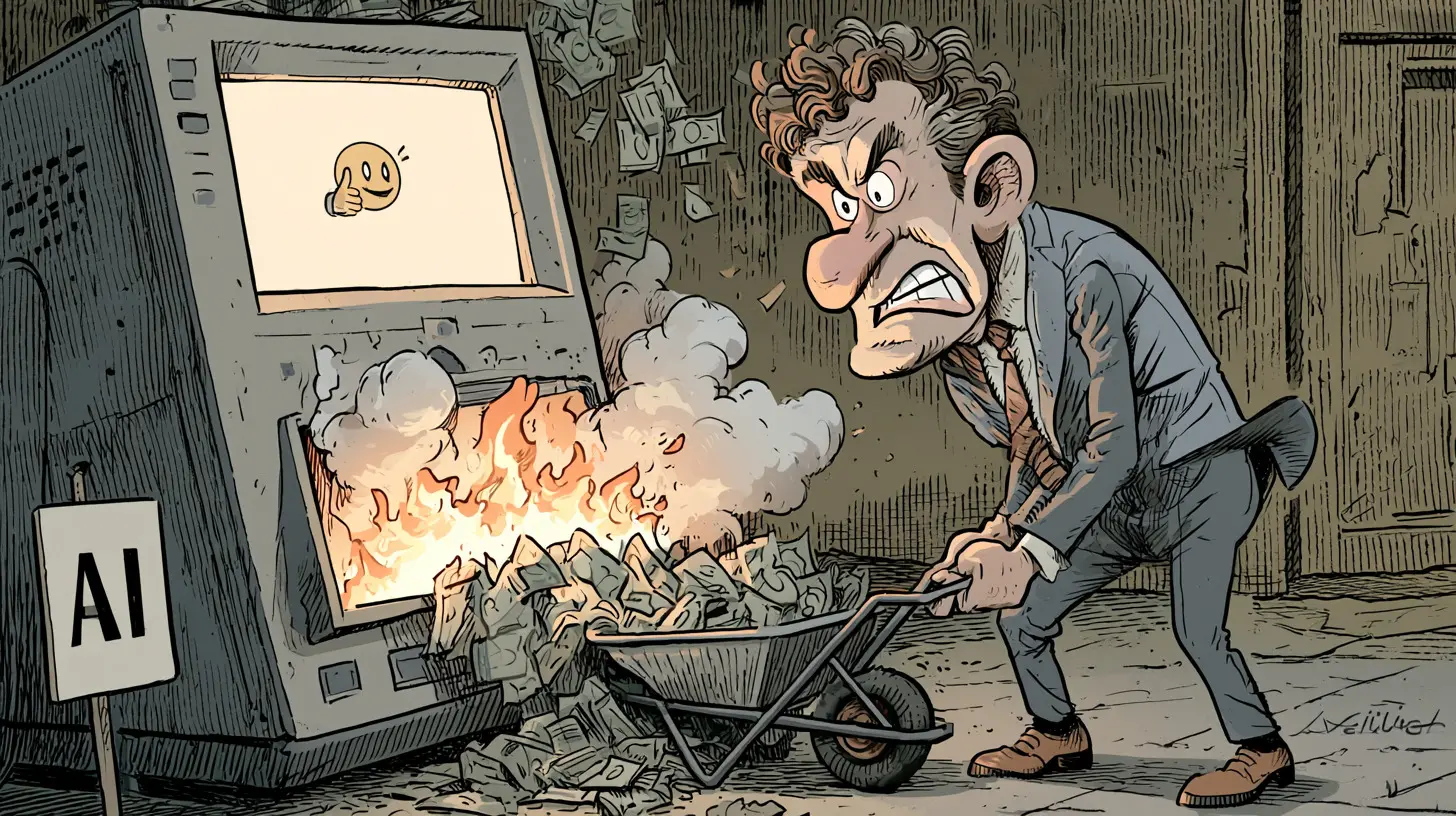
The promise of artificial intelligence as a cost-saving tool for businesses is facing a harsh reality check. A recent incident involving an unspecified company that reportedly burned through $500 million in Claude credits in a single month after forgetting to set usage limits has sent shockwaves through the corporate world. This staggering oversight is just the latest example of how the unchecked adoption of generative AI can lead to ballooning expenses, counteracting the very efficiency gains that were supposed to justify the investment. As more companies grapple with similar budgeting nightmares, the narrative around AI is rapidly shifting from unconditional enthusiasm to cautious reevaluation.
The $500 Million Oversight
According to a paywalled report by Axios, an unnamed company failed to establish guardrails on employee usage of Anthropic's Claude AI model. Without any caps or monitoring, employees freely used the AI for tasks ranging from code generation to drafting emails, racking up an astronomical bill. The $500 million figure is not just a cautionary tale but a real-world example of how easily AI costs can spiral out of control. This incident highlights a critical flaw in the enterprise adoption of AI: the assumption that AI will automatically reduce costs without proper governance. In many organizations, the focus has been on deploying AI as quickly as possible to stay competitive, often sidelining essential infrastructure for tracking and limiting usage. The result is a financial blow that could easily dwarf the initial savings projected from automation.
Tokenmaxxing and the AI Budget Crisis
The new term "tokenmaxxing" has emerged to describe the tendency among employees to consume AI credits as rapidly as possible, often without regard for utility. This behavior is fueled by the perception that AI tools are a bottomless resource, especially when access is provided without clear boundaries. The company in question is not alone. Uber recently made headlines when its engineers exhausted the entire company's AI budget for 2026. Uber's new COO, Andrew Macdonald, publicly expressed concerns that AI-related costs and token usage have not improved worker productivity as much as anticipated. These examples have prompted corporate leaders to ask tough questions about the return on investment of generative AI.
The problem is compounded by the pricing models of major AI providers. Google, Anthropic, and others have shifted to usage-based billing, which means costs rise linearly—or even exponentially—with increased usage. While this model aligns revenue with service consumption, it places the burden of cost control entirely on the customer. Enterprises that fail to implement strict usage policies are vulnerable to runaway spending. The $500 million incident is a stark reminder that AI is not a fixed-cost utility; it is a variable expense that can quickly exceed budget forecasts if not managed diligently.
Corporate Pushback and Cost Realities
As the financial impacts of unchecked AI usage become clearer, a growing number of companies are pushing back against the technology. Leaders at major brands such as Costco, Delta Airlines, and IBM have voiced skepticism about AI's value. They are advocating for retaining human workers, especially in roles where AI has yet to demonstrate consistent productivity gains. This sentiment stands in contrast to the aggressive cost-cutting strategies at Amazon, Meta, and Microsoft, where thousands of jobs have been eliminated in favor of automation. The divergence in corporate strategy highlights the uncertainty surrounding AI's true economic impact.
Even companies that have bet heavily on AI, like Microsoft, are beginning to retreat from their earlier enthusiasm. Earlier this month, Microsoft reportedly started canceling Claude subscriptions and discouraging employees from using the model excessively. This move comes just six months after Microsoft promoted a "vibe-coding" culture, encouraging employees across various departments to use AI for rapid prototyping and development. The reversal indicates that the cost of AI usage may outweigh the benefits in many day-to-day tasks, especially when employees rely on it for simple activities that could be done manually just as quickly.
The broader trend of tokenmaxxing is now seen as a liability. Corporate executives are realizing that giving employees a "free rein" with AI tools leads to waste and inefficiency. Instead, companies are beginning to budget AI usage more carefully, restricting it to high-value activities such as complex data analysis, customer service automation, and specialized content generation. This shift from blanket access to targeted deployment is likely to redefine how enterprises integrate AI into their workflows.
Future Outlook: Cost Reduction vs. Usage Explosion
Despite the current cost challenges, the trajectory of AI model economics suggests that inference costs will decline over time. A recent report from Gartner predicts that by 2030, the inference costs for generative AI models will be only a tenth of what they were in 2025. This is encouraging news for enterprises looking to expand their AI adoption without breaking the bank. However, the same report warns that token usage could grow by a factor of five to thirty times current levels. With the rise of autonomous AI agents and increasingly complex workflows, the sheer volume of AI calls could offset any per-credit savings. Enterprises must therefore plan for a future where AI usage grows exponentially, even if the unit cost drops.
Providers are responding to this tension by developing more cost-efficient models and inference techniques. Google, for example, has invested heavily in lightweight models like Gemini Nano and optimized inference pipelines that reduce operational costs. Anthropic is also working on more efficient versions of Claude. These efforts are essential for making AI sustainable for large-scale deployments. However, they do not absolve companies from their own responsibilities in managing usage. Without internal controls, even the cheapest AI models can lead to substantial aggregate costs.
The $500 million incident serves as a wake-up call for the entire corporate ecosystem. It demonstrates that the technology itself is only one part of the equation; effective governance is equally important. Companies must establish clear limits, monitor usage trends, and educate employees about the financial implications of their AI interactions. Some organizations are already adopting pre-paid credits or departmental budgets to enforce discipline. Others are implementing approval workflows for high-volume tasks. These measures, while initially burdensome, are necessary to realize the long-term benefits of AI without sacrificing financial control.
The AI bubble, as some have called it, may not burst entirely, but the dream of a costless productivity revolution is beginning to fade. Enterprises are learning that every AI interaction has a cost, and that cost must be managed just like any other resource. As more incidents like the $500 million oversight come to light, it is likely that we will see a broader industry shift toward responsible AI consumption. The future of AI in the enterprise will be shaped not only by technological advancements but by the ability of organizations to deploy these powerful tools within sustainable financial frameworks.
Source: Android Authority News